

close
Choose Your Site
Global
Social Media
Author: Site Editor Publish Time: 2026-04-24 Origin: Site
A Mechanical Level Gauge is often the first solution considered when monitoring fuel levels in diesel generator trailers, especially in environments where reliability matters more than complexity. In our experience at Dongguan Dalang Aoer Parts Ltd., customers frequently ask whether they should stay with a mechanical system or upgrade to electronic sensors. Both options have clear advantages, but the right choice depends on how the generator is used, where it operates, and what level of monitoring is required. This article breaks down the differences from a practical, application-focused perspective to help users make a confident decision.
Diesel generator trailers are typically used in demanding and often unpredictable environments. They may be deployed on construction sites, in emergency response scenarios, at outdoor events, or in remote areas where a stable power supply is critical. In these situations, fuel is the lifeline of the entire system, and knowing the exact fuel level is not just convenient—it becomes an operational necessity.
Unexpected fuel shortages can lead to immediate power loss, which may halt construction work, interrupt critical operations, or compromise safety systems. For example, in emergency backup situations, a generator running out of fuel could result in serious consequences, including equipment damage or system failure. On the other hand, inaccurate readings that suggest more fuel than is actually available can create false confidence, delaying necessary refueling actions.
At the same time, overfilling the fuel tank can also cause problems. Fuel overflow not only wastes resources but can also pose environmental and safety risks. Spillage may damage surrounding equipment or create hazardous conditions on-site. This makes accurate and reliable fuel level monitoring essential for both efficiency and safety.
Another important factor is operational planning. In many cases, generator trailers are part of a larger system, and fuel consumption needs to be monitored to schedule refueling cycles properly. A dependable monitoring system allows operators to plan ahead, reduce downtime, and optimize fuel usage across multiple units.
Because of these reasons, the fuel level monitoring system must be dependable, easy to read, and capable of performing consistently under real working conditions. Whether the environment involves vibration, dust, or temperature fluctuations, the system must continue to provide accurate and timely information without requiring constant attention or maintenance.
A mechanical level gauge is a straightforward and practical device designed to measure fuel levels using physical movement rather than electronic signals. Its design is based on a simple principle, which makes it both reliable and easy to understand.
The system typically consists of a float placed inside the fuel tank, connected to an external indicator through a mechanical linkage. As the fuel level rises or falls, the float moves accordingly. This movement is directly transferred to the indicator, allowing users to visually check the fuel level without any need for electronic conversion or digital processing.
One of the most significant advantages of this design is that it operates independently of any power supply. The entire system relies on mechanical motion, which means it continues to function even if the generator’s electrical system is unavailable or unstable. This makes it particularly suitable for remote or off-grid applications where electrical reliability cannot always be guaranteed.
Electronic fuel level sensors represent a more advanced approach to measuring and displaying fuel levels. Instead of relying on mechanical movement alone, these systems use electrical signals to detect and transmit fuel level data.
Depending on the design, electronic sensors may use different technologies. Float-based sensors convert mechanical movement into electrical signals, while capacitive sensors measure changes in capacitance caused by varying fuel levels. Ultrasonic sensors, on the other hand, use sound waves to determine the distance between the sensor and the fuel surface.
Once the fuel level is detected, the sensor sends a signal to a display unit or a central control system. This information can then be presented in digital form, often with higher resolution and more precise readings compared to mechanical systems.
Understanding the key differences between these two systems helps users choose the most suitable option for their specific needs.
Mechanical gauges rely on direct physical movement to indicate fuel levels. The float inside the tank moves with the fuel, and this movement is directly displayed. Electronic sensors, by contrast, convert physical changes into electrical signals, which are then processed and displayed digitally.
This fundamental difference affects how each system responds to environmental conditions and operational demands.
Mechanical level gauges operate without any external power source. This makes them highly reliable in situations where electrical systems may fail. Electronic sensors, however, depend on a stable power supply, and their performance can be affected by issues such as battery failure or wiring faults.
Mechanical gauges are generally easier to install due to their simple design. They require fewer components and do not involve complex wiring. Electronic sensors require more careful installation, including proper wiring, calibration, and sometimes integration with control systems.
Mechanical systems are straightforward and easy to inspect. Most issues can be identified visually, and maintenance is relatively simple. Electronic systems may require diagnostic tools and technical knowledge to troubleshoot, especially when dealing with signal or connectivity issues.
Diesel generator trailers are often exposed to vibration, dust, temperature changes, and rough handling.
Mechanical level gauges are highly resistant to these conditions because they have fewer sensitive components. Their simple structure makes them less vulnerable to environmental factors.
Electronic sensors, while capable of high accuracy, may be affected by harsh conditions if not properly protected. Moisture, dust, and vibration can interfere with electrical connections and sensor performance.
For outdoor or rugged environments, mechanical solutions often provide more consistent reliability.
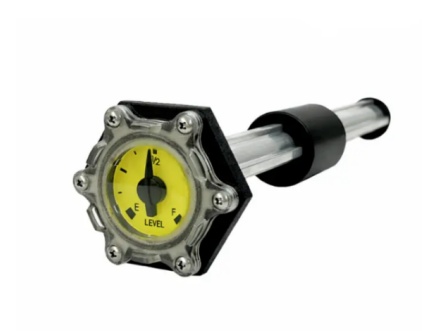
Electronic sensors are generally capable of providing more precise measurements. They can display detailed fuel levels and integrate with monitoring systems.
However, in many real-world scenarios, reliability is more important than extreme precision. A slightly less precise reading that is always available is often more valuable than a highly accurate reading that may fail under certain conditions.
Mechanical level gauges provide consistent and immediate visual feedback, which is sufficient for most generator trailer applications.
Cost is another important factor when choosing between these two options.
Mechanical level gauges typically have lower initial costs and minimal operating expenses. They do not require additional electronics or complex installation.
Electronic systems may involve higher upfront costs due to sensors, wiring, and control units. Maintenance and potential repairs can also increase long-term expenses.
For many users, especially those managing multiple generator units, the cost advantage of mechanical systems is significant.
A mechanical level gauge is often the preferred option in the following situations:
remote or off-grid environments where power supply is limited
applications requiring simple and reliable operation
conditions involving vibration, dust, or harsh weather
projects where cost efficiency is a priority
In these cases, the simplicity and durability of a mechanical system provide clear advantages.
Electronic sensors may be the better choice when:
remote monitoring is required
integration with digital systems is necessary
high measurement precision is critical
the operating environment is controlled and stable
These systems are well suited for advanced setups where data tracking and automation are important.
Factor | Mechanical Level Gauge | Electronic Sensor |
Power requirement | None | Requires power |
Installation | Simple | More complex |
Reliability | High in harsh conditions | Depends on protection |
Accuracy | Moderate | High |
Maintenance | Low | Moderate to high |
Cost | Lower | Higher |
Monitoring | Local visual | Remote possible |
Choosing between a mechanical system and an electronic solution depends on balancing reliability, cost, and functionality. A mechanical system remains a strong choice for many diesel generator trailers because of its simplicity and durability. At Dongguan Dalang Aoer Parts Ltd., we focus on providing dependable solutions that meet real operational needs, and our experience shows that a well-designed fuel tank mechanical gauge can deliver consistent performance in demanding environments. If you are evaluating fuel level solutions for your generator trailer, contact us to explore options that match your application.
It operates without electricity and provides reliable fuel level readings even in harsh environments.
Yes, electronic sensors generally offer higher precision, but they may require stable conditions and power supply.
Mechanical level gauges are often better suited due to their durability and resistance to environmental factors.
Yes, it is ideal for remote applications because it does not depend on electrical systems.


